Top Trending Technologies in 2026: Latest Technology Trends, AI, Cybersecurity & Future Opportunities
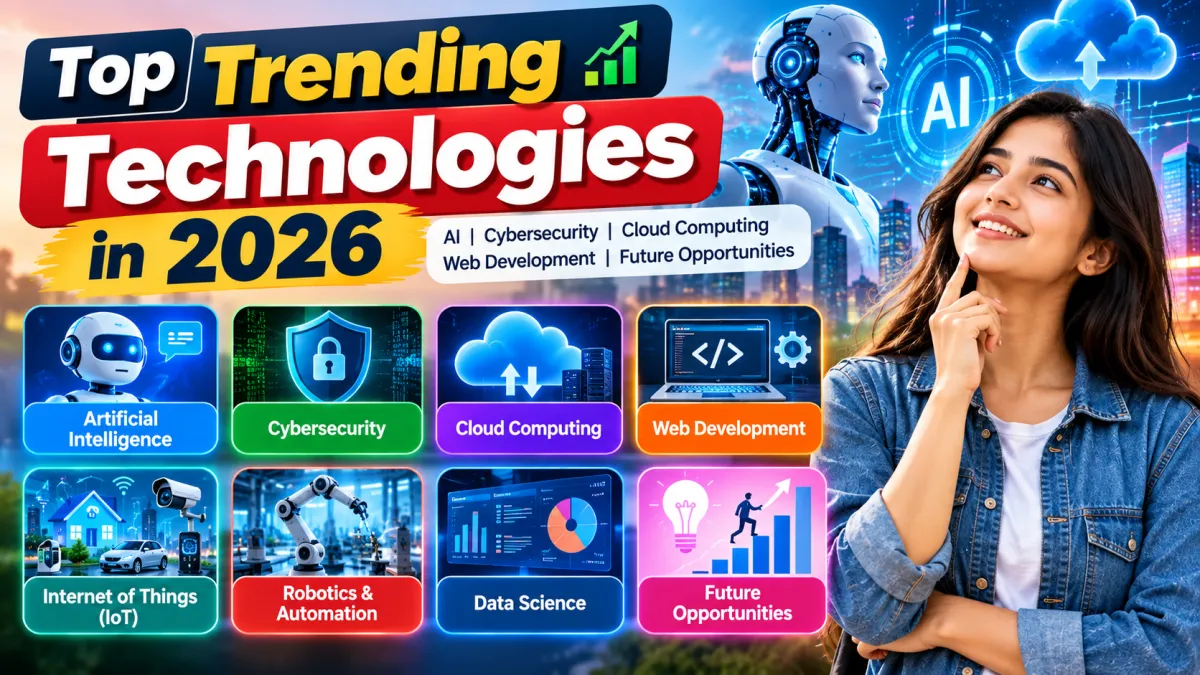
Top Trending Technologies in 2026: Latest Technology Trends, AI, Cybersecurity & Future Opportunities
Technology is changing the way businesses operate, people communicate, and organizations deliver services. From Artificial Intelligence (AI) and AI agents to cybersecurity, cloud computing, and intelligent automation, the latest technology trends are creating new opportunities for businesses, developers, students, and entrepreneurs.
In 2026, companies are increasingly focusing on practical AI applications, secure digital infrastructure, automated workflows, and smarter software solutions. Gartner's technology outlook for 2026 highlights AI-native development platforms, multiagent systems, AI security platforms, and preemptive cybersecurity among important strategic technology trends. Source
If you want to understand the latest technology trends in 2026, this article explores the most important innovations, their business applications, career opportunities, and how companies can use technology to improve productivity and growth.
1. Artificial Intelligence (AI): The Biggest Technology Trend
Artificial Intelligence continues to influence software development, customer service, marketing, education, healthcare, and financial services. AI-powered tools can analyze information, generate content, assist with coding, and automate repetitive business activities.
Businesses are adopting AI to improve efficiency, personalize customer experiences, and make better use of their data.
How AI Is Transforming Businesses
- Automated customer support through AI chatbots.
- AI-powered content creation and marketing assistance.
- Intelligent data analysis and reporting.
- Personalized recommendations for customers.
- Automated document processing and business workflows.
For example, an organization can integrate an AI chatbot into its website to answer common questions, collect customer enquiries, and direct users to the appropriate department.
SEO keywords: Artificial Intelligence trends 2026, AI technology, AI solutions for business, AI-powered software development.
2. AI Agents and Intelligent Automation
One of the important emerging technology trends in 2026 is the development of AI agents. Unlike a conventional chatbot that mainly responds to prompts, an AI agent can be designed to complete a sequence of tasks using approved tools, business data, and defined instructions.
For example, a business development workflow might use an AI agent to categorize incoming leads, prepare a follow-up message, and update a CRM system after receiving appropriate authorization.
Potential applications include:
- Customer relationship management.
- Automated report generation.
- Document classification and processing.
- Workflow coordination.
- Internal knowledge assistance.
However, AI agents require appropriate permissions, monitoring, and human oversight, particularly when handling payments, personal information, or important business decisions. Gartner identifies multiagent systems and AI security as significant areas of technology development for 2026. Source
3. Cybersecurity and Data Protection
As businesses become more dependent on digital platforms, protecting websites, applications, customer information, and business systems is increasingly important.
Cybersecurity involves the technologies and processes used to protect digital assets against unauthorized access, malware, phishing, ransomware, and data breaches.
Important Cybersecurity Practices
- Implement multi-factor authentication.
- Keep software, plugins, and server environments updated.
- Use HTTPS and secure communication protocols.
- Maintain regular backups.
- Apply role-based access control.
- Monitor suspicious activities and access logs.
- Follow secure coding and data protection practices.
AI is influencing both cyberattacks and defensive security systems, making effective security governance increasingly important. Source
For businesses operating websites or custom software, cybersecurity should be included from the planning and development stages rather than added only after a problem occurs.
SEO keywords: Cybersecurity trends 2026, website security services, data protection, secure software development.
4. Cloud Computing and Cloud-Native Development
Cloud computing allows businesses to use computing resources, databases, storage, and software services over the internet instead of depending entirely on local infrastructure.
Organizations use cloud platforms to host websites, deploy applications, store business data, and scale resources according to demand.
Cloud-native development takes this approach further through technologies such as containers, orchestration platforms, automated deployment pipelines, and microservices.
Benefits of Cloud Technology
- Flexible infrastructure and resource scaling.
- Easier application deployment.
- Improved collaboration between distributed teams.
- Support for backup and disaster recovery strategies.
- Infrastructure options for AI-powered applications.
Indian developers are also adopting cloud-native technologies, with hybrid cloud becoming an important deployment model in the country's cloud-native ecosystem. Source
Businesses should choose their infrastructure according to application requirements, data sensitivity, budget, expected traffic, and operational capabilities.
5. Web Development and AI-Powered Websites
Web development remains essential for businesses that want to build an online presence, generate leads, provide digital services, or sell products.
Modern website development combines responsive design, secure backends, optimized performance, accessible interfaces, and integrations with business tools.
AI can enhance websites through conversational assistants, intelligent search, content recommendations, and automated customer enquiry management.
Modern Website Development Trends
- Mobile-first responsive website design.
- AI-powered chatbots and search.
- Progressive Web Apps (PWAs).
- API-based integrations.
- Improved website speed and accessibility.
- Secure payment gateway integration.
- Search engine optimization (SEO).
For example, an NGO can use a website to manage donations, publish projects, register volunteers, and provide online receipts. A service company can use a business website to generate enquiries and organize customer follow-ups.
A well-designed website should not only look professional but also deliver a useful experience, load efficiently, protect user information, and support measurable business goals.
6. Low-Code and AI-Assisted Software Development
Software development is evolving as AI coding assistants and low-code platforms help developers create prototypes, generate code suggestions, and automate repetitive programming tasks.
These tools can support application development, testing, documentation, and maintenance. They do not eliminate the need for software engineering fundamentals, security reviews, or testing.
Businesses can use these approaches to accelerate internal tools, dashboards, customer portals, and workflow applications.
For successful implementation, developers must still validate generated code, check dependencies, review access controls, and test performance before releasing applications to production.
SEO keywords: AI software development, latest software development trends, custom business software, low-code development platforms.
7. Internet of Things (IoT) and Smart Devices
The Internet of Things connects physical devices such as sensors, machines, vehicles, and monitoring equipment to digital systems.
IoT technology can collect real-time data and help organizations monitor operations, identify inefficiencies, and automate selected activities.
Common IoT Applications
- Smart homes and connected appliances.
- Industrial equipment monitoring.
- Agricultural irrigation and soil monitoring.
- Logistics and asset tracking.
- Energy consumption monitoring.
- Healthcare monitoring devices.
When IoT is combined with AI, connected systems can analyze incoming data and identify patterns that support maintenance and operational decisions.
However, connected devices must be configured securely, updated regularly, and protected against unauthorized access.
8. Robotics and Physical AI
Robotics is moving beyond repetitive industrial automation toward systems that can interpret their surroundings and respond to changing conditions.
Physical AI combines AI capabilities with machines, robots, sensors, and other physical equipment. Potential applications include warehouse operations, manufacturing, agriculture, logistics, and selected healthcare tasks.
Companies are exploring these technologies to improve consistency, reduce certain operational risks, and automate tasks that are difficult or repetitive for people.
Adoption depends on implementation costs, reliability, safety requirements, and the environment in which the equipment operates. Physical AI is among the technology areas highlighted in 2026 industry outlooks. Source
9. Data Science and Business Intelligence
Businesses generate information through websites, sales systems, customer interactions, finance platforms, and marketing campaigns. Data science and business intelligence help transform this information into useful insights.
Organizations can use dashboards and analytical tools to understand sales performance, customer behaviour, expenses, operational efficiency, and marketing results.
Business Applications of Data Analytics
- Sales and revenue reporting.
- Customer segmentation.
- Inventory forecasting.
- Financial performance monitoring.
- Marketing campaign analysis.
- Automated management information systems (MIS).
For example, a company can use a centralized dashboard to monitor leads, customer conversions, revenue, and monthly expenses instead of maintaining separate spreadsheets for every department.
Accurate data, suitable reporting methods, and access controls are essential for reliable results.
10. Future Technology Skills and Career Opportunities
The growth of digital technologies is creating opportunities for students, professionals, freelancers, and entrepreneurs. The most useful skills depend on the industry, the type of role, and the learner's existing experience.
Some areas worth exploring include:
- AI and machine learning fundamentals.
- Python programming and data analytics.
- Web development using modern frontend and backend frameworks.
- Cloud computing and DevOps.
- Cybersecurity fundamentals.
- UI/UX design.
- Mobile application development.
- Automation and API integration.
Students should begin with core concepts, build practical projects, and learn how to solve real problems. A portfolio demonstrating working applications and practical experience can be valuable when applying for jobs or freelance projects.
Professionals should also develop communication, analytical thinking, documentation, and collaboration skills alongside technical knowledge.
11. How Businesses Can Adopt the Latest Technology Trends
Following every new technology is not necessary for every business. The right solution is the one that addresses a genuine business need and provides measurable value.
Consider the following approach:
Step 1: Identify a problem. Determine whether the priority is lead generation, customer support, reporting, security, or operational efficiency.
Step 2: Choose suitable technology. Compare available tools and development approaches against your requirements and budget.
Step 3: Start with a manageable project. Test the solution with a limited workflow before expanding it across the organization.
Step 4: Protect business data. Apply access controls, security reviews, backups, and appropriate privacy measures.
Step 5: Measure performance. Evaluate improvements in productivity, response time, customer experience, and operating costs.
Step 6: Improve continuously. Update the system as business requirements, user feedback, and technology capabilities evolve.
Conclusion
The latest technology trends in 2026 demonstrate how AI, AI agents, cybersecurity, cloud computing, web development, IoT, robotics, and data analytics are reshaping modern businesses.
For organizations, adopting the right technologies can improve workflows, strengthen security, support informed decisions, and create better digital experiences. For students and professionals, developing practical skills in these areas can open opportunities for learning and career growth.
At Gentle Innovation Technology, businesses can explore website development, custom software solutions, mobile applications, and digital services that support their operational and online growth.
If your organization is planning to modernize its website or develop custom business software, start by identifying your requirements and selecting a secure, scalable solution that fits your goals.
Build smarter. Work efficiently. Grow digitally.